
Welcome to Nats Journal
Your new home for Washington Nationals news, analysis, podcasts and community

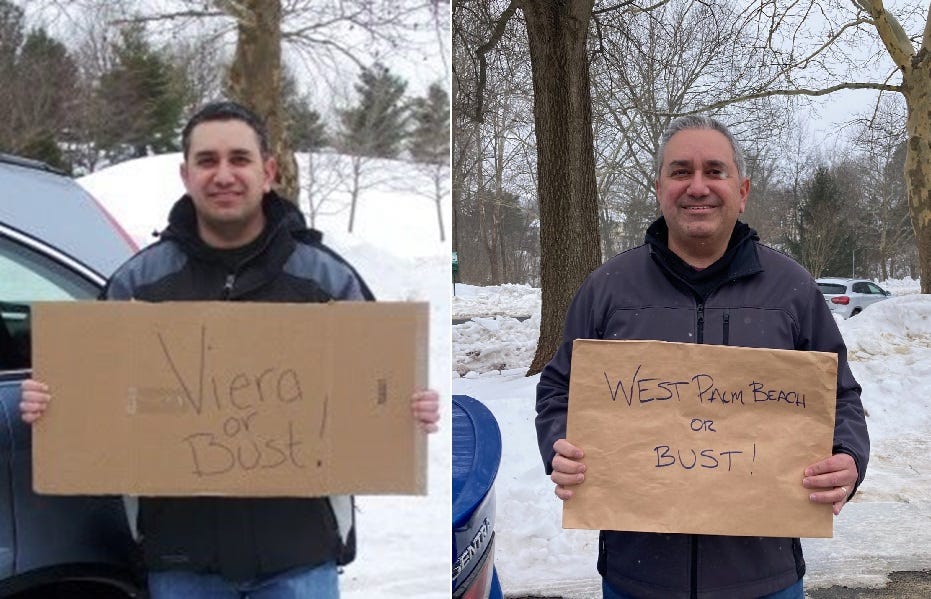
Look at that bright-eyed, 33-year-old sportswriter in the photo on the left. Recently laid off from his newspaper job, he had no idea what he was doing, but he figured it was worth seeing if he could continue to cover the Washington Nationals as an independent reporter, asking readers to fund his trip to spring training.
Now look at that gray-haired, 49-year-old sportswriter in the photo on the right. Recently laid off from his digital broadcasting job, he still has no idea what he’s doing. But this time, he believes covering the Nationals as an independent reporter can be more than a temporary fix. He believes it can become a legitimate, professional operation.
A lot has changed since February 2010. For the Nationals, who back then were hoping a No. 1 draft pick named Stephen Strasburg would help lead the franchise to its first taste of success and now hope a No. 1 draft pick named Eli Willits will eventually be part of the franchise’s next winning roster. And for the journalism industry, which has seen the financial woes that destroyed small-to-medium newspapers back then now come for some of the largest (and seemingly most secure) media outlets with even more damaging results.
When the Nats won the World Series in 2019, there were no fewer than seven professional outlets that covered the team on a regular basis. For the last few days, that number has been reduced to one: MLB.com, the league-owned website that employs reporters for all 30 clubs.
The numbers already had been dwindling in recent years, with The Athletic, ESPN.com and the former NBCSportsWashington.com dropping their Nationals coverage. And they plummeted to depths previously unimaginable in recent weeks with my layoff from MASN (after the club opted to take over their own television rights) and the elimination of nearly the entire Washington Post sports department, a development that still doesn’t sound real to anyone who has lived in this area for any length of time and relied on the Post as the local news outlet of record.
Well, that changes today. Because I’m back to work, doing the same job I’ve done for 21 years in a brand-new forum, one that feels ready to succeed in this ever-changing media landscape we’re all trying to keep up with.
Welcome to Nats Journal, your one-stop shop for complete coverage of the Nationals by an experienced, professional journalist who has been around for every step of this franchise’s roller coaster existence since arriving in town in 2005.
The name has been slightly tweaked – let’s just say there were some annoying roadblocks preventing me from reacquiring the old name from 2010 – but the mission remains the same. If you want daily coverage of your favorite ballclub, from the first day of spring training to the final day of the season and throughout the winter, this is your destination. If there’s breaking news, you’ll find it here. If there’s a game on the schedule, there will be coverage of it. If there’s an interesting story to tell, I’ll tell it.
And I’ll try to give you much more than the basic facts. You’ll get the who, the what, the where and the when. But the real goal here is to give you the why. Why was that roster move significant? Why was tonight’s game important in the bigger picture? Why was the quote from the manager or the president of baseball operations or the player meaningful in the grander scheme of things?
I’ll do my best to provide all of that to you by using the best tool professional journalists have at our disposal: access. There’s no substitute for covering a ballclub in person, being in the clubhouse before and after games, asking questions of the manager every single day, developing relationships with the people who make the team run. That kind of access, whether it produces on-the-record quotes, off-the-record insight or simple observations made possible just by being there from February through September (or, yes, even October), is what distinguishes beat reporting from any other type of coverage you’ll find out there.
Unfortunately, it’s not cheap to cover a major league team. Spring training is a significant expense (especially West Palm Beach vs. Viera). So is the regular season, especially with full interleague play adding more cross-country trips than used to occupy the schedule.
Which is why this is a subscription-based website. You’re not required to pay to access the site, though let’s be upfront about this: A majority of the articles here will reside behind a paywall. You’ll also need to be a paying subscriber to post comments and participate in regular Q&As with me.
The pricing structure, though, offers something for everyone. If you don’t want to make a long-term commitment, you can subscribe for $7.99 per month. If you do commit for a full year, the price drops to $5.99 per month. There’s also an upper tier category for the true diehards who want to further support this endeavor.
You might be thinking to yourself right now: How many people does he really think are going to pay to read about the 2026 Nationals, a team that’s five years into a rebuild and by all accounts starting all over with a new front office and coaching staff? I suppose we’re about to find out, but I’m willing to bet there are a lot more of you out there than many assume.
I’ve said this before, but I’ll continue to say it: D.C. gets a bad rap as a sports town. Maybe all four major local franchises are down at the moment, but we’ve seen how much this city rallies behind a success story.
Did you know over the entirety of their history here, the Nats have drawn an average of 2,238,432 fans per season? That works out to an average crowd on any given night of 27,635. (Those figures exclude 2020-21, when there were COVID restrictions.) The numbers obviously go up during winning seasons and go down during losing seasons, but even so this team has never drawn fewer than 1.8 million fans in a single year. There’s only been one crowd in club history with an official announced attendance under 10,000, and that was for the first game of an April 2022 doubleheader against the Diamondbacks.
Yeah, things are down right now. It was a rough winter, and a 100-loss season feels way more plausible than an 80-win season. But if you’re reading this, your interest in this team remains strong. If the reaction to last month’s trade of MacKenzie Gore to the Rangers for five prospects confirmed nothing else, it was this: You care.
I also know this because the most recent episode of Nats Chat – the podcast I’ve hosted with Al Galdi and Tim Shovers since 2021 and will continue to host, with daily direct access from this site – featuring an interview with Paul Toboni is now the second-most-downloaded episode in the show’s history, trailing only last July’s episode after Mike Rizzo and Davey Martinez were fired.
You care. You care about the product on the field. You care about the promise of better days to come. You care about this new regime’s attempt to overhaul the entire organization in a manner that hasn’t been done around here in a very long time. You care about ownership’s level of commitment to provide that new front office the resources it wants to build a team that not only can win in the near future, but then sustain that success for many years beyond. You care.
I’ve interacted with so many of you over the last 21 years, whether in-person or online. And I remain as convinced as I’ve ever been that the Nationals fan base is among the brightest, most engaged and most supportive fan bases in the sport. You appreciated 2019 not just because of what happened during that glorious year, but because of everything that happened in the years leading up to it. And whenever this franchise climbs that mountain again, you’ll appreciate it even more because of the winding journey it took to get back there.
So let’s start a new portion of that journey right here. Pitchers and catchers report to spring training tomorrow. And so do I.
West Palm Beach or Bust.
Subscribed as founding member. I’ve been avidly reading Mark since 2005 and quality journalism should be supported (and essentially used money I saved by canceling the Washington post).
I unsubscribed from WaPo a while ago anyway. Would much rather spend that money supporting this.