

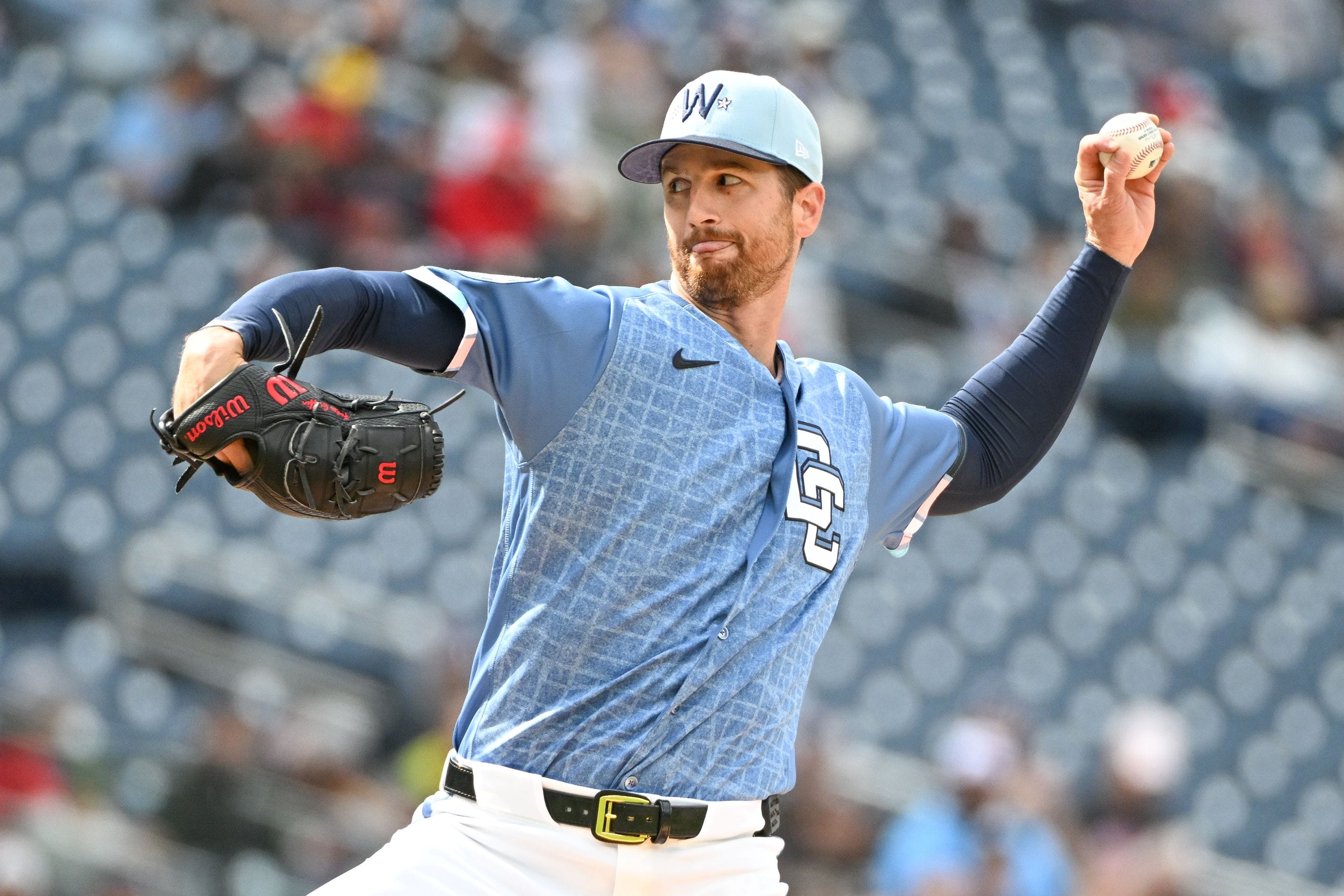
If you’ve been following Nats Journal since our launch three months ago, you know one of the perks of being a Founding Member is the opportunity to ask questions of Nationals players, coaches and executives. Blake Butera was first to participate back in spring training, then Cade Cavalli took his turn in April.
Now it’s time for our May participant: Foster Griffin. The 30-year-old left-hander has been quite the revelation since the Nats signed him out of Japan over the winter for a mere $5 million, developing into the team’s most-reliable starter (even with some recent struggles against the Reds and Mets).
Subscribers sent in their questions earlier this week, and I selected the best ones to ask Griffin on Wednesday afternoon (the day after his most recent start). As you might imagine, many of the questions had to do with Japanese baseball and his return to the major leagues. So I wound up combining a bunch of those into one all-encompassing question, listing off everyone’s name who asked some version of that question.
Thanks to everyone for the great submissions. And if you’d like a chance to send in questions of your own next time around, please consider upgrading to a Founding Member subscription. If not, no worries. Thank you for subscribing at whatever level you prefer – we’re at more than 7,000 total subscribers (paid plus free) and counting, which is a big deal considering that’s how I’m making a salary and paying for travel expenses!
OK, here we go with Griffin’s Q&A ...
How did you get to have seven different pitches? What was the catalyst, because it doesn’t seem to be the norm? – Rebecca
I just couldn’t get any swing-and-miss in Japan, especially, because they’re just not known for striking out. So that’s the reason behind it. I just wanted to get more swing-and-miss. I had to create new pitches in order to do so.
My family went to Japan in June 2023 to celebrate our son’s college graduation and we went to a Yomiuri Giants game at the Tokyo Dome. While we didn’t get to see you pitch that game, we did experience a truly unique atmosphere as baseball fans. So I’d like to ask about your perspective of pitching in front of an NPB vs. MLB crowd. And as a follow up, what aspect of the game/fan experience would you like to see brought to MLB? – Mark
The fan experience in Japan is unlike anything, ever. I mean, obviously a packed playoff game in Philadelphia is pretty loud, pretty crazy. But they get 35,000-plus there (in Japan) every single night. Each player has a song and chant, and they’re loud. Playing in front of their fans, especially at the Tokyo Dome each night, was a blessing and something I’ll never forget.
And the thing I like the most about the fan experience over there was: Even when you would go on the road, the road team had a specific section blocked off for the opposing team, whether it be the band or our fan section. So when we’d go to Osaka, it would be a sea of black and yellow, and then there’d be a little strip of orange for the Giants. That was pretty cool to see. In each city, you had your little section, and your little band cheering section as well.
“Comparables” for you are rare. If I look back in time, there are guys like Dallas Keuchel or Wade Miley, but I don’t know of any still-young lefty starters who don’t have high velocity but are consistently effective by relying on a very large mix of off-speed stuff. Are there any major leaguers, past or present, who you would compare yourself to? – Scott
Hmm, I don’t like comparing myself. I’ll answer it in a different way. There’s not necessarily anybody I compare myself to that had a bunch of different pitches, but as a kid I watched a lot of Cliff Lee. Someone who maybe didn’t have an overpowering fastball, but it definitely felt like he was a student of the game and a competitor and was able to mix and match locations as well as speeds, and did a good job as a left-handed starter.
I have read that you are a big fan of The Office. What is your favorite episode, and what Nats player is most like Dwight Schrute? – Ray
Man, that’s really hard. It would have to be the episode where they bring in the safety officer, where they do CPR on the dummy (“Stress Relief,” Season 5). That one’s probably up there for me. Who’s most like Dwight Schrute? Probably Gus Varland.
What were the biggest challenges adjusting to Japanese baseball and overall culture? What have been the biggest challenges adjusting back to American baseball and overall culture? – Dwight, Andrew, Travis, Alice, Larry, Michele, James, Tom, Kurt, Doug, Kaizad, Ike, Steve and Susan
Adjusting to Japanese baseball, for sure, would be twofold. One, I had to hit. That was a challenge of conserving energy, honestly. It was a lot different. And just the style of baseball. I had to get better at fielding my position, which I feel like I did get a lot better at over there. But also navigating a lineup and knowing what my strengths are. Like, when I can pitch around this hitter to get to the pitcher. And that kind of answers the other question about coming back here. You’ve got 1 through 9 trying to do damage. So that’s a lot different, having to adjust planning-wise for that.
Culturally, I didn’t have a problem adjusting to the culture. I love the culture over there. The people were great. The fans were so awesome. Even if they’d see you out and about, no one really bothered you a ton. They might come up to you and take a picture, but it was very harmless. The only challenge, especially early on when I was there, was the language barrier. It’s pretty tough. It’s just a totally different language. It’s not something you can just pick up. You have to study it more to learn it. And then my wife and I would always joke when we’d come back here – because we would spend nine months over there; it’s a long season with spring training so early – as soon as you land back here, it’s very strange being able to understand what everybody’s saying when you get to the airport. With how tired you are, and then all of a sudden you’re listening to other people’s conversations? It’s very shocking once you get back to the States.
Do hitters expect the (excellent) cutter on a crucial pitch, like a 3-2 count? – Ned
Yeah, that’s something I’ve got to get better at. That’s something I’ve learned over my 10 starts: There are times when I can get predictable. And even if it’s a good pitch, if a major-league hitter knows a certain pitch is coming, they’re going to be pretty good at it. That’s not saying I’m never going to throw it 3-2. It’s still going to be my highest-percentage pitch most likely. But I still have to pick and choose my spots on when I’m getting too predictable with it and stay away from it.
Japan is known as a crucible for pitchers, raising them to be workhorses. The 2025 postseason performances of Ohtani, Sasaki and Yamamoto exemplify this. Would more non-Japanese pitchers benefit from pitching in Japan as you did, or are you an exception? – Maurice
I don’t know how many people know this, but there’s only four foreigners allowed per team over there. So I consider myself very fortunate and lucky to have been scouted by a Japanese team and then have the opportunity to go over there and do well. There’s some guys who get scouted and go there, and it’s basically like a yearlong tryout. Everyone signs a one-year deal. It’s basically a tryout. If you don’t do well, or you just do OK, oftentimes you don’t get asked to come back. I was very fortunate and lucky to get the opportunity to go, and then take advantage of it and do well and be able to spend a couple years there. I would encourage any player that gets the opportunity to go there to go, depending on where they are in their career. I was definitely a 4-A player at the time, so it was kind of a no-brainer for me. But it’s just not for everybody. The culture doesn’t fit everybody. The baseball lifestyle doesn’t fit everybody. I loved it, but I feel like each situation is very specific.
Great start to the season. You wouldn’t be human if you haven’t thought ahead to next year, even just a little bit. How do these things normally work? Will your representative wait for the Nationals to reach out? At some point this year, would your representative reach out proactively? Assuming, of course, that you’d be interested in returning. – Jim
That’s why we hire agents, right? I have too much to focus on here for me to focus on anything like that. I’d love just the opportunity to play in the major leagues next year. That’s all I want to be able to do. So if I start thinking about stuff like that, that’s going to take away from the things I need to do in between my starts to get ready for the next day. I know it’s not an answer you probably want to hear, but that’s the reason we have representation, and I’ll let them handle that. And let the Nats front office know as well. They know how to contact our representation. That doesn’t just speak for me. It speaks for everybody else in the clubhouse. I just focus on what I can do in between the lines here and let my representation sort that out.
Well done Nats fans, great questions and thanks to Foster for enlightening us on his experiences. Great read
That was a fun read! Thanks Mark and everyone who asked Q’s.